
NAND Flash Prices Are Soaring in 2026 — When Will They Finally Fall?
If you have been shopping for SSDs, SD cards, or USB drives recently, you have probably noticed something alarming: prices are climbing fast, and they do not seem to be stopping.
Since November 2025, NAND Flash contract prices have surged 20% to 60% across every capacity segment from 128Gb to 2Tb. Some enterprise-grade products jumped 80% in a single month. The first quarter of 2026 brought another 33% to 38% increase, and analysts at TrendForce expect a further 70% to 75% rise in the second quarter.
This is not a short-term fluctuation. It is a structural supply–demand imbalance driven by the artificial intelligence boom, and it will shape the entire memory industry for the next several years.
Why Are NAND Flash Prices Rising So Fast?
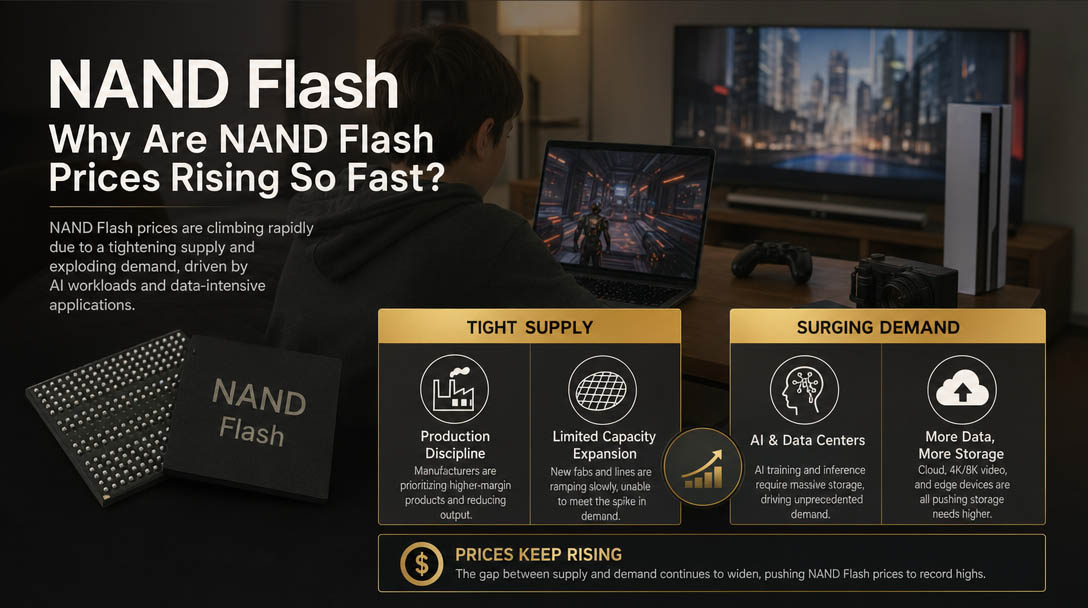
Supply Side: Manufacturers Are Deliberately Cutting Back
The big three — Samsung, SK Hynix, and Kioxia — have been aggressively shutting down older production lines. Fabrication plants running 128-layer NAND and below are being decommissioned at an unprecedented pace. Global NAND output fell 15% year-on-year in 2025, and consumer-grade capacity shrank by a full quarter.
Manufacturers are redirecting their fabs towards 176-layer and 232-layer 3D NAND. During this generational transition, structural supply gaps are simply unavoidable. At the same time, companies are flooding far fewer chips into the spot market, preferring to serve long-term contract customers. If you are buying on the open market, finding reliable stock has become a genuine challenge.
There is another reason for this restraint. In 2022, the 512Gb wafer price collapsed from $4 to $1.40 — a loss that cost the industry billions. That memory still haunts boardrooms across South Korea and Japan. Nobody wants to repeat it. Capital expenditure remains cautious despite the surge in pricing.
And perhaps the biggest factor reshaping the supply landscape: HBM. High-bandwidth memory delivers far better margins than NAND. The same companies — Samsung, SK Hynix, Micron — are prioritising their capital towards HBM for AI accelerators. NAND comes second in the pecking order, and that has profound consequences for availability.
Demand Side: AI Is Consuming Every Available Chip
A single eight-card AI server requires over 2Tb of enterprise SSD capacity — five to eight times more than a traditional server. Global AI server shipments grew 120% year-on-year in 2025. China's top cloud providers alone purchased 10EB of new storage, a figure that would have been unthinkable just three years ago.
Enterprise SSDs from SK Hynix are already sold out for the whole of 2026. Lead times have stretched from six weeks to twelve, and they continue to lengthen. Customers are being told to wait months for delivery.
Meanwhile, on-device AI is pushing flagship smartphones from 128Gb to 512Gb or even 1Tb of storage. A single phone now uses three times the NAND it did two years ago. Hard drive shortages have also pushed data centres towards large-capacity QLC SSDs as an alternative, adding another layer of demand.
The consumer electronics refresh cycle is compounding the problem. Personal computers and smartphones are reaching end-of-life simultaneously, and buyers want devices capable of running local AI models. Every new device adds to the strain.
The Macro Picture
Geopolitical sanctions on Chinese memory producers such as Yangtze Memory Technologies have further disrupted the global supply landscape. The balance of power has shifted entirely: manufacturers no longer chase demand — demand chases manufacturers.
Downstream module makers and end brands are stockpiling in anticipation of further rises, which tightens supply even further. The feedback loop is self-reinforcing.
A Quick Timeline of the NAND Cycle
Understanding the broader cycle helps put current prices into context:
| Period | What Happened |
-------- |
-------------- |
2022 |
Price collapse — 512Gb wafer $4 → $1.40 |
2023–2024 |
Prolonged slump, capex cuts across the industry |
Early 2025 |
Giants begin "cut volume, hold price" strategy |
April 2025 |
SanDisk leads the charge — consumer products up 10%+ |
November 2025 |
Full-scale surge — every segment up 20–60% monthly |
Q4 2025 |
NAND average price rebounds 63.6% cumulative |
Q1 2026 |
Contract prices rise another 33–38% |
Q2 2026 |
Expected further rise of 70–75% |
Full year 2026 |
Demand growth 35% vs supply growth 20% — prices up another 15–25% |
When Will Prices Actually Come Down?

Short Term — Second Half of 2026: Do Not Expect Relief
Demand is growing at 35% while supply manages only 20%. The gap is widening, not closing. SK Hynix and other major players have already committed their entire 2026 output to contracted buyers. Every credible industry forecast points to a further 20% to 30% increase before the year ends.
Medium Term — 2027: Early Signs of a Turning Point
New capacity announced in 2026 typically takes twelve to eighteen months to come online. That means the earliest meaningful supply increase arrives around mid-2027.
Watch these four indicators closely:
- Are manufacturers increasing capital expenditure significantly? If fab investment picks up, more supply is on the way.
- Are enterprise SSD lead times falling below eight weeks? Shorter lead times mean loosening supply conditions.
- Are next-generation QLC and PLC yields improving? Higher yields translate directly into more usable output.
- Is AI server shipment growth slowing? Even a modest deceleration in AI demand would ease pressure considerably.
Long Term — 2028 and Beyond: The Downcycle Is Almost Certain
History has a pattern. Previous NAND price surges lasted two to three years — the 2016 to 2018 cycle and the 2020 to 2022 cycle both followed this trajectory. When new capacity arrives all at once and AI demand growth naturally decelerates, the market flips. Supply overwhelms demand, and prices tumble.
There is one caveat worth noting. After the 2022 crash, manufacturers will be far more disciplined about overproducing. The next downturn will likely be gentler and slower than the last one. Do not expect another $4-to-$1.40 collapse.
Price Forecast Summary
| Period | Price Trend |
Probability |
Key Variables |
-------- |
------------ |
------------- |
--------------- |
H2 2026 |
Up 15–25% |
High |
AI demand stays strong |
H1 2027 |
Single-digit increases |
Medium |
New capacity begins trickling in |
H2 2027 |
Stabilisation or slight decline |
Medium |
Depends on capacity release pace |
2028+ |
Downcycle begins |
Medium–High |
Supply–demand reversal confirmed |
What This Means for the SD Card Industry
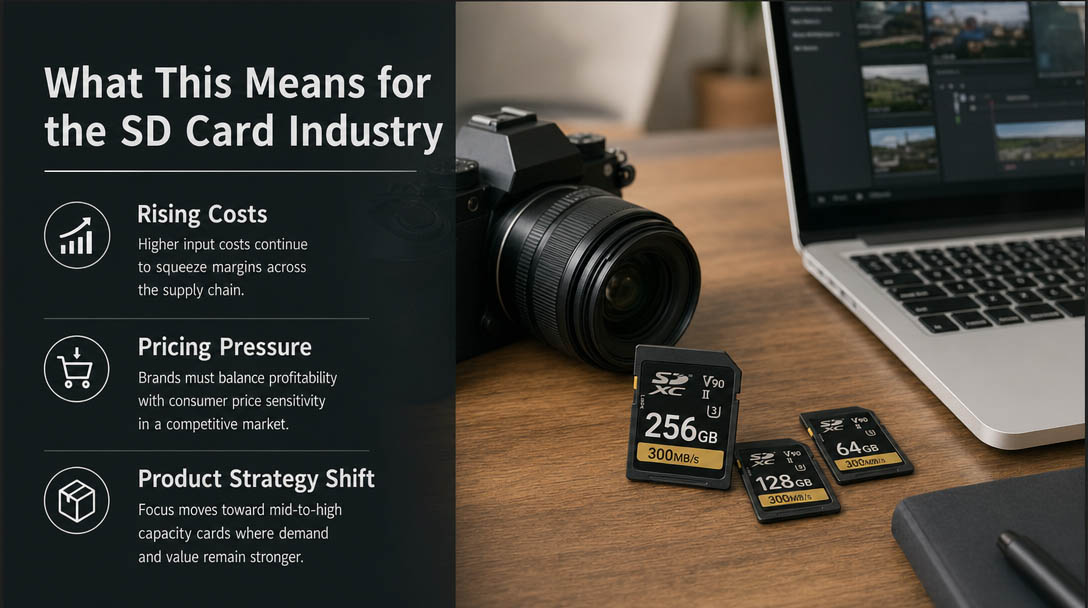
For companies producing SD cards, microSD cards, and embedded storage, the impact is direct and unavoidable. NAND wafer prices flow straight through to manufacturing costs. There is no buffer, no shortcut around it.
Low-capacity products face the worst pressure. The older production lines for 128Gb and below are the ones being shut down first. If your product range relies on these legacy nodes, sourcing will become increasingly difficult and expensive.
The most sensible responses are straightforward: sign long-term supply agreements with upstream wafer fabs to lock in pricing where possible; shift the product mix towards higher-margin large-capacity and industrial-grade cards; and build strategic inventory — though carrying too much stock at peak prices carries its own risks. Ultimately, some cost pass-through to end customers is simply inevitable.
The Bottom Line
This rally is driven by artificial intelligence — real, structural demand, not speculation. Prices will keep rising through 2026. The earliest realistic window for a downturn is the second half of 2027.
For anyone in the memory supply chain, the message is clear: prepare for higher costs as the new normal. Track three indicators above all else — manufacturer expansion plans, AI server shipment data, and enterprise SSD lead times. When all three start moving in your favour, the tide is finally turning.
Until then, buy what you need, when you need it, and do not wait for a bargain that is not coming anytime soon.